


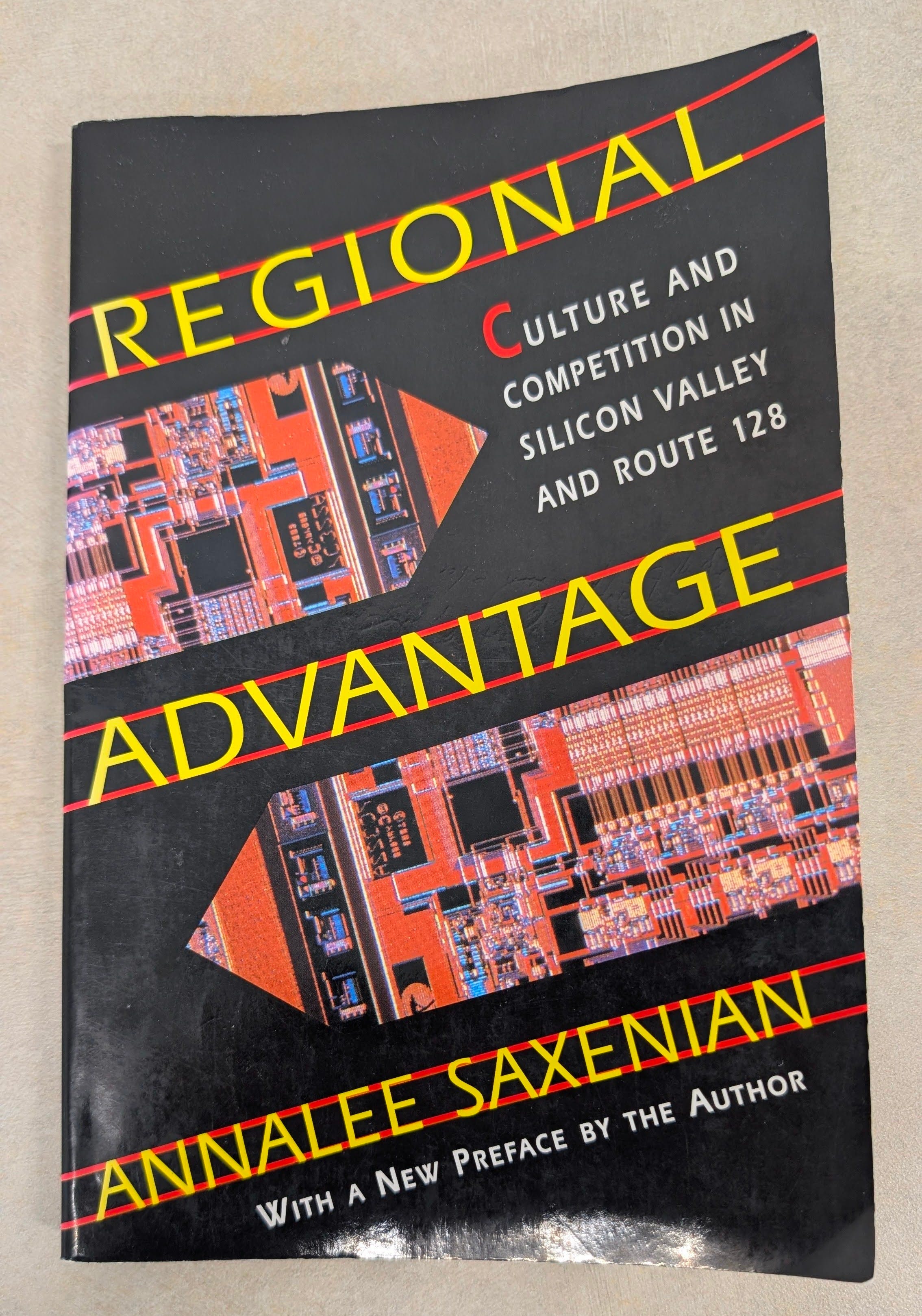
I’ve been reading AnnaLee Saxenian’s Regional Advantage, which my colleague Stephen Hicks first pointed me to. It’s thirty years old, but its central question has never felt more current. Why do some regions out-innovate others that start with the same ingredients?
There’s a fitting irony in the source. Saxenian is a Berkeley scholar. She earned her master’s in regional planning here, has taught at Berkeley since 1989, and spent fifteen years as Dean of the School of Information. The definitive account of why Silicon Valley pulled ahead was written just up the hill from where we now sit, trying to build what comes next.
The lesson from Route 128
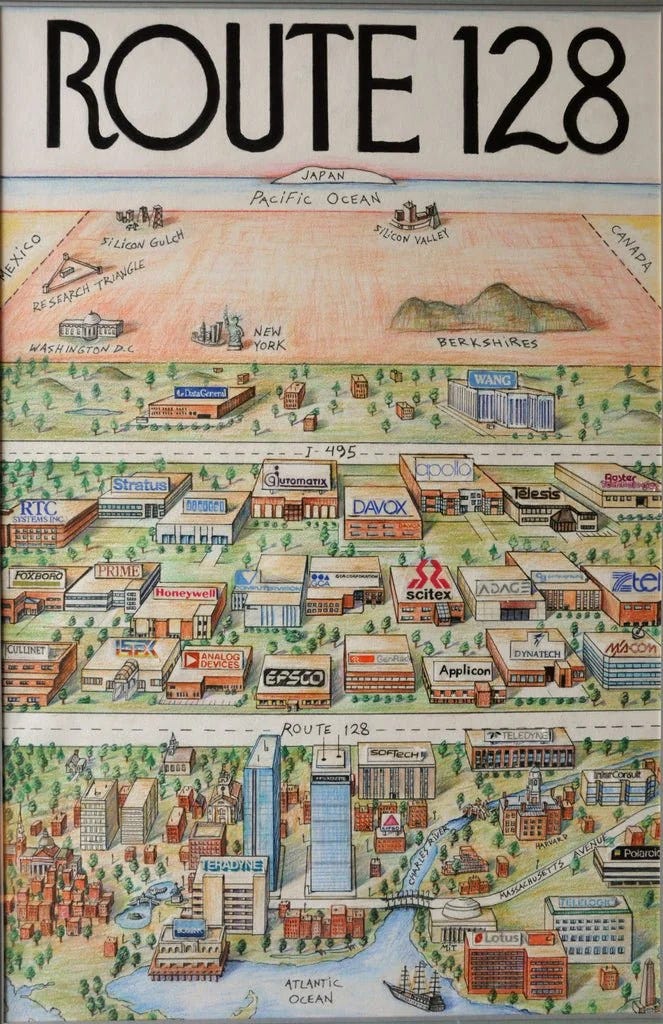
Saxenian’s argument is simple. In the 1980s, Silicon Valley and Route 128 outside Boston had comparable talent, capital, and university strength. MIT matched Stanford. Yet the Valley pulled ahead and Route 128 stagnated. Her explanation wasn’t tax policy or weather. It was culture and structure.
Route 128 ran on vertically integrated, secretive firms. Companies like DEC and Data General kept knowledge inside their walls, discouraged job-hopping, and treated knowledge as something to be walled in, not shared. When the market shifted, that rigidity became fatal.
Silicon Valley worked the opposite way. Engineers moved between companies. Information crossed firm boundaries. Informal networks, shared suppliers, and a norm of collaboration meant the region learned faster than any single company could. The network, not the firm, was the unit of advantage.
That is the ecosystem we're designing at the Berkeley Gateway Accelerator: porous boundaries over walled gardens, density as infrastructure, and a community whose relationships de-risk hard science.
Why this is personal
I didn’t come to this book as a neutral reader. I grew up inside the story it tells.
My father, Irving Rappaport, spent his career as a patent attorney and intellectual property lawyer at the companies Saxenian wrote about. He ran IP at Medtronic in the early 1970s, then was recruited to Westborough Massachusetts as chief patent counsel at Data General, one of the flagship Route 128 firms. He worked in that ecosystem before heading west to run intellectual property at Apple, which he joined in the mid-1980s, around the time Steve Jobs was on his way out and Jean-Louis Gassée was taking over product.
So he saw both regions from the inside, and he reached Saxenian’s conclusion years before I read her book. The thing he told me that stuck was simple. The best part of working in Silicon Valley, he said, was that if you wanted to change jobs or lost one, there was always somewhere else to go. Talent moved, knowledge moved, and nobody treated it as betrayal. Someone arriving from a competitor was normal, even welcome. The idea of an agreement that legally blocked a person from moving between companies was absurd.
There’s a legal reason his instinct tracked the region’s success. California has banned most non-competes for over a century, under a statute that voids contracts restraining someone from practicing their profession. Massachusetts enforced them for decades. That single difference is one of the underappreciated reasons the two regions diverged. The Valley’s labor mobility wasn’t only cultural. It was legally protected. Engineers could carry what they knew across the street, and the law was on their side. Route 128 firms could lock that knowledge down, and did.
Having spent my own career in IP strategy, I find this the most interesting tension in the story. The patent bargain gets it right: an inventor gets twenty years of exclusivity in exchange for publishing how the invention works, which pushes everyone else to design around it and build something better. The bargain protects the invention while keeping the knowledge in circulation. What it never does is lock up the inventor. You protect the idea and free the person, and the design-around is a feature, not a leak. A region that lets knowledge move learns faster than one that doesn't. That's the lesson my father lived, and it's one I'm now trying to build into an institution.
But there’s a part of Saxenian’s story that gets quoted less often, and it is essential for the growth of the East Bay.
The regional network was never just engineers
Silicon Valley’s advantage wasn’t only that tech experts talked to each other at parties. The whole production ecosystem was dense and local. Chip designers were down the road from the fabs. Prototype shops, suppliers, contract manufacturers, and the technicians who ran them were part of the same web. The tacit knowledge that made the Valley resilient lived on the factory floor as much as in the design lab.
As a country, we spent forty years hollowing that out. We kept the high-margin design work and sent the making overseas. For consumer software, maybe that was survivable. For deep tech (robotics, advanced energy, quantum hardware, semiconductors) it's a liability. You can’t iterate on a physical product when your prototype cycle runs through a supply chain twelve time zones away. Reshoring deep tech supply chains isn’t just an industrial-policy talking point. It’s a precondition for building hard technology quickly and securely.
The honest objection: hasn’t Silicon Valley already won?
In a brief conversation with Stephen Hicks, the gentleman who recommended the book, he asked the hardest questions head-on, hasn’t the East Bay’s advantage already been harvested? For decades, Berkeley and the national labs have produced first-rate talent and foundational science, and much of the company-building and wealth that followed migrated south. The East Bay has too often been a feeder. We invent it here; it gets built and monetized there. If that’s the pattern, isn’t it too late to change it?
My answer is that it was too late a decade ago to out-software Silicon Valley, and no one should try. That game is over, and the Valley won it. But that isn’t the game in front of us. The frontier has moved to deep tech and hard manufacturing, and the Peninsula is poorly positioned to play. It has limited room and little appetite for it. Land is scarce and priced accordingly, the making was offshored long ago, and the culture is built for asset-light software on short timelines. Hard tech needs what the East Bay still has and the Peninsula doesn’t: research universities and national labs next to affordable industrial land, a deepwater port, and a manufacturing workforce. The window is open because the industry moved onto terrain where our assets matter and theirs don’t.
So this isn’t about throwing a punch at Silicon Valley and beating it at its own game. That would be futile, and it would misread Saxenian, whose whole thesis is that regions win through openness, not rivalry. It’s about building the layer Silicon Valley can’t. We’re not the underdog trying to dethrone the champion. We’re the logical home for what comes next.
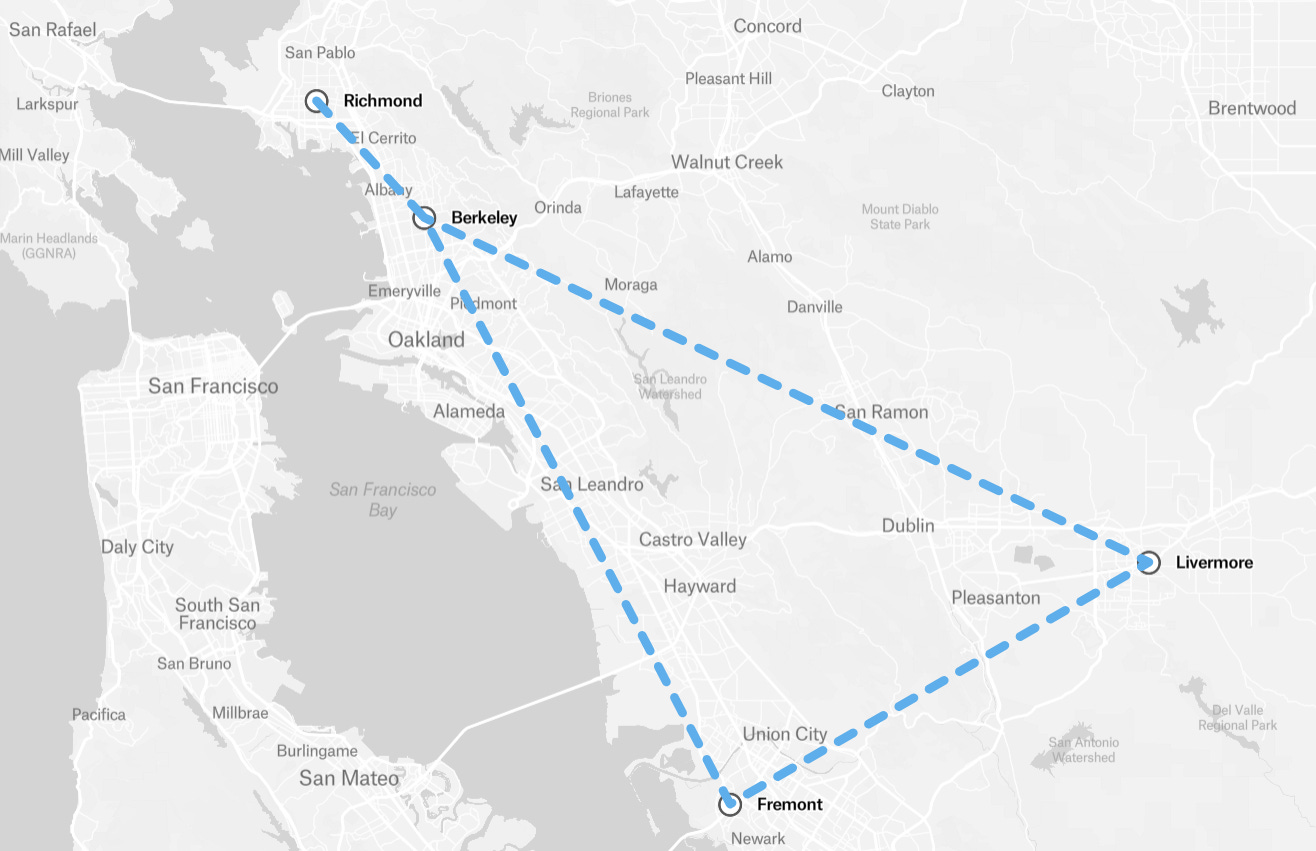
That’s the region we’re trying to name into existence. Call it the East Bay Frontier: the place where hard science gets invented and built in the same square mile. The Peninsula became “the Valley.” This is the Frontier.
The East Bay Frontier
We have the ingredients. We’ve been missing the engine.
There’s a precedent worth noting. In 1946, Stanford’s trustees created the Stanford Research Institute, later SRI International, as an engine to turn university science into companies and regional growth. SRI spun off dozens of ventures, from the computer mouse to surgical robotics to the technology behind Siri. The lesson isn’t to copy Stanford. It’s that a strong research base doesn’t automatically become a strong regional economy. Someone has to build the institution that turns science into companies, on purpose.
The East Bay has never lacked ingredients. We have a top research university and, in Lawrence Berkeley National Laboratory and its sister labs, one of the densest concentrations of national-lab science in the country. What we’ve lacked is our own translational engine, an institution built to keep the value here instead of watching it drain south. That’s the gap BGA is meant to fill. We don’t need to borrow Stanford’s institution. We can build our own, anchored in Berkeley’s Lab lineage and its research strength.
Doing it the right way
If the East Bay is going to build the next deep tech region, we should be clear about the failure modes of the last one, and honest that we mean to avoid them.
The Valley’s mythology celebrates openness and mobility, and Saxenian showed that openness was the real source of its strength. But it didn’t always live up to its own story. In the High-Tech Employee Antitrust Litigation, filed in 2011, some of the region’s most admired companies (Apple, Google, Intel, Adobe) settled for $415 million over secret no-poach agreements alleged to have suppressed the wages of roughly 64,000 engineers. The complaint named Steve Jobs among the architects. The irony is hard to miss. The region built on labor mobility, the mobility my father praised, produced the most notorious documented effort to kill it. The stated value and the private conduct pointed in opposite directions.
I raise this not to score points against Silicon Valley, which is still a remarkable place, but because building the next region is a chance to hold the values more honestly than the last one did. That means labor mobility as a real commitment, not a slogan contradicted behind closed doors. It means opportunity that reaches beyond the already-advantaged. It means treating the people who make the technology, not just the people who design it, as full members of the ecosystem.
Broadening the talent base
Here’s the conviction that increasingly drives our thinking at BGA. To build a deep tech region that lasts, we can’t rely only on the engineers and scientists coming out of UC Berkeley and other top universities. We need them, and they’re the reason a place like BGA can exist. But a region built on that talent alone is narrow, and a narrow region is fragile.
The East Bay has a chance to do something the Peninsula never did: build its innovation economy with its working communities, not around them. The Valley grew up next to places like East Palo Alto and largely left them behind. We have a deep, diverse base of working people and the institutions that train them. Community colleges like Laney, Berkeley City College, and Diablo Valley. Technical and vocational programs. Apprenticeship pipelines. The people who run a CNC machine, manage a prototyping lab, troubleshoot a production line, and hold a supply chain together.
Deep tech generates exactly the work these institutions train for: precision manufacturing, prototyping, quality control, logistics, supply chain. These are good, durable jobs. They’re also the jobs that let a deep tech region build things rather than just design them.
A more equitable tide
There’s a version of the innovation economy that lifts a few already-advantaged people very high and leaves everyone else to absorb the rising cost of living. We’ve all watched it happen. It breeds resentment, displaces communities, and wastes an enormous amount of regional talent.
The version we want looks different. A deep tech ecosystem anchored in Berkeley but reaching across the East Bay, connecting the university’s research strength to the manufacturing, prototyping, and supply chain capacity of the wider community. University-trained scientists and community-college-trained technicians in the same web, on the same problems, with real pathways between them. That’s what the Frontier has to mean if it’s going to mean anything.
That’s what a rising tide should mean. Not trickle-down from a handful of unicorns, but a broader base of people with a stake in, and a paycheck from, what’s built here.
How we plan to build it
Vision without mechanism is just a nice essay, so here’s how we’re approaching it.
Start with the companies, early. We back founders at the earliest stage, when a team is still a few people and the manufacturing need is months or years off. That's exactly when the trajectory gets set. Where a company puts down roots, the contract manufacturer it picks for its first build, the place it opens its first line, the habits it forms about where to source, all tend to harden fast and rarely get revisited. Keeping these companies in the East Bay as they grow, rather than watching them migrate south the moment they scale, is part of our mandate. By working with founders before those defaults lock in, we can build local roots, local-first sourcing, and East Bay hiring into how they grow, so that when a company does scale its build-out, it stays and staffs it here rather than relocating or defaulting to a distant supplier.
Connect every level of training to the work, from the research lab to the machine shop. That means UC Berkeley and its engineering and science pipelines, and it means Laney, Berkeley City College, Diablo Valley, and the apprenticeship and vocational programs already here. It should reach earlier than that, too, into East Bay high schools and their career-technical and STEM programs, so a kid in Richmond or Oakland can see a real path into this work before they ever have to choose a college. The point is to link these levels, not rank them: co-designed curricula, shared access to prototyping and fabrication space, instruction from working founders and engineers, and internship and apprenticeship slots inside cohort companies. A PhD candidate and a high school student in a machining class should both be able to find their way onto the same team. The goal is a visible path into real deep tech work, whether it starts with a doctorate, a two-year degree, a certificate, or a high school shop class. We've started down this road already: our Summer Academy brings high school and undergraduate students into the accelerator alongside founders and researchers, so the exposure starts early and the path is something they can see rather than take on faith.
Build shared physical infrastructure. One of the biggest barriers for hard-tech startups is access to machine shops, fabrication space, and prototyping equipment. Shared facilities do double duty. They lower the cost of building for founders, and they become training grounds where students and technicians work alongside the teams commercializing new technology.
Make the pathways two-way. A technician who starts on a prototyping line should be able to grow into a lead role, a production manager, or a founder. The Valley’s magic was mobility. We want mobility that runs not just laterally between firms but upward through a career, open to people who didn’t start with a PhD.
None of this happens by accident, and none of it happens if we treat blue-collar talent as an afterthought to the “real” innovation. It has to be designed in from the start.
What Saxenian would say
Saxenian was writing about resilience. Adaptive regional networks outlast rigid hierarchies. Four decades later, as deep tech and dual-use innovation reshape which regions matter, the lesson feels urgent rather than nostalgic. But the deeper point, the one worth carrying into the East Bay, is that a regional network is only as strong as it is inclusive. The Valley won because knowledge flowed across boundaries. Our task is to draw more people inside those boundaries in the first place.
We’re not trying to recreate 1985 Silicon Valley. We’re trying to build something better: a deep tech region that makes as well as it designs, and lifts a wider community as it grows. The East Bay Frontier, if we build it right.
We can’t do it alone, and we’re not trying to. A region is built by a community leaning in: universities and community colleges, high schools and trade programs, manufacturers and investors, philanthropy, city governments, and the working people who will actually build these things. It takes all of them choosing to invest in the place rather than watch its best ideas leave.
And it’s worth doing because of what these companies are building. The technologies coming out of this ecosystem, in advanced energy, robotics, quantum, and hard manufacturing, are aimed at problems that matter, not at squeezing more attention out of a screen or shaving a few points off an ad-targeting model. There’s a version of tech that makes real things that improve real lives, and a version that mostly enriches itself. We know which one we want the East Bay Frontier to be known for.
I’d welcome thoughts from others working on this. What would it take to knit the East Bay’s universities, community colleges, and manufacturing base into one deep tech ecosystem?
This article was written with support from Claude.com
Reading Saxenian changed my MBA career and is basically why I’m faculty. This is on the shelf in my home office.