


If you have seen Everything Everywhere All at Once, you already have a feel for this. A laundromat owner discovers that every choice she never made is playing out in some other universe, and that she can reach across to them. Behind all the chaos, the premise comes almost directly from physics.

There is an idea in quantum mechanics strange enough that Niels Bohr once said anyone who isn’t shocked by the theory hasn’t really understood it. I keep coming back to it, not for the physics, but because it is the most hopeful way I have found to think about a life, a career, a company.
The physics underneath is genuinely strange. At the smallest scale, a particle does not sit in one fixed state. It exists as a spread of possibilities, a wave of everything it might be. Physicists call this superposition. But the moment you measure it, the moment it gets observed, all those possibilities become just one. The famous double-slit experiment shows it: left alone, a particle behaves like a wave moving through every path at once; watched, it picks one. People call this the observer effect. Observing it is what produces a single outcome.
One reading of all this, the many-worlds view that Hugh Everett proposed in 1957, is stranger still. It says the possibilities never reduce to one at all. Reality just splits. Every outcome happens, each in its own branch, and we travel down the one we happen to be in. That is the premise behind Sliding Doors, where catching or missing one train splits a woman into two separate lives, and Mr. Nobody, where a boy’s every choice forks into a different future. Stories like these stick with us because they name something we already suspect, that any moment could have gone another way.
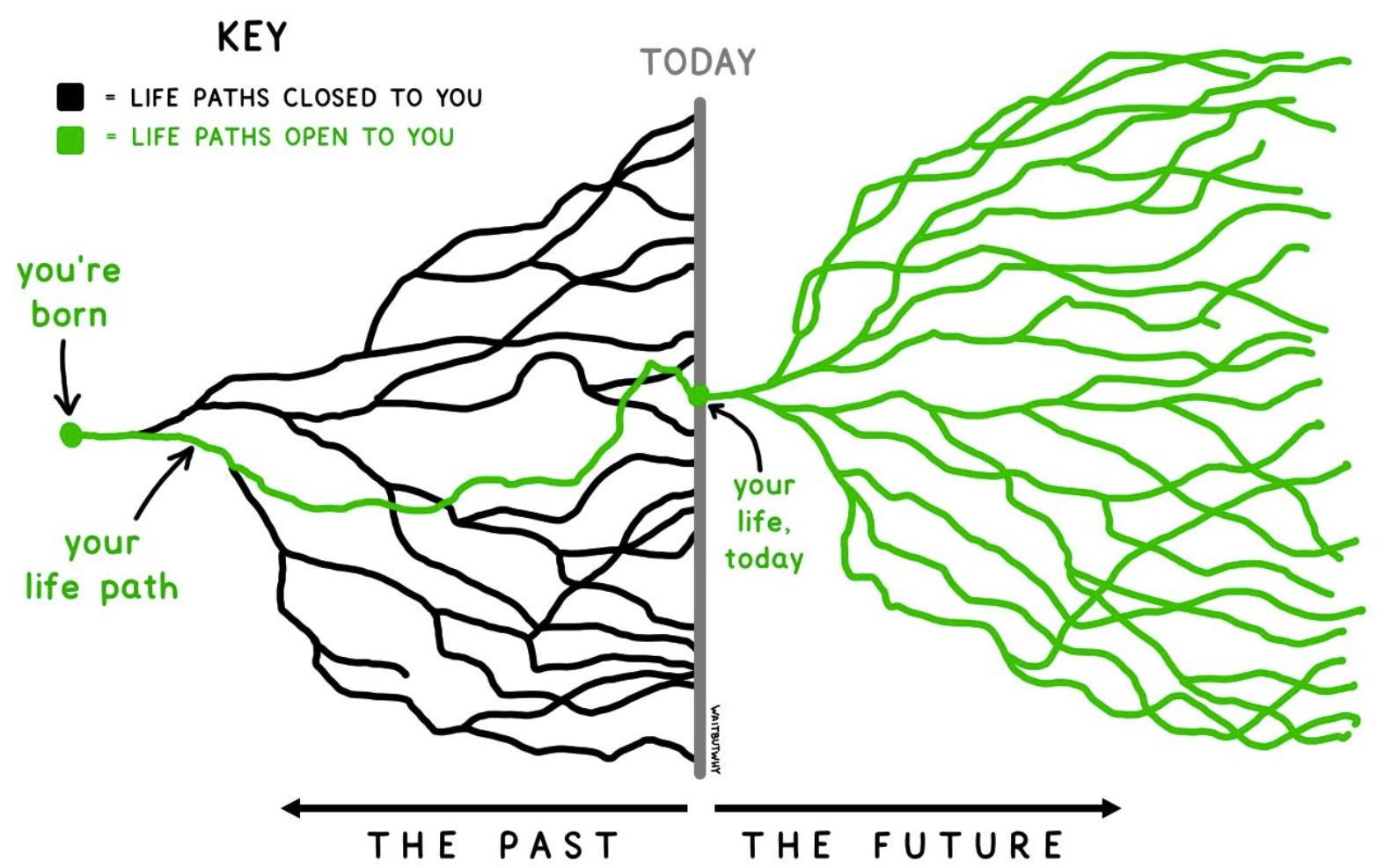
You don’t need the physics to be literally true for this to matter. Your future is not a single track running toward a fixed destination. It stays unsettled until you act. Each decision we make is a measurement of its own. Each choice makes one world real and leaves a thousand others on the table.
A student’s path is not written yet. A researcher’s question is already shaping the answer that will come back. For someone building a company, the market is not finished and waiting to be found; what you do helps bring it into being. And on any ordinary morning, for any of us, the day is not decided in advance.
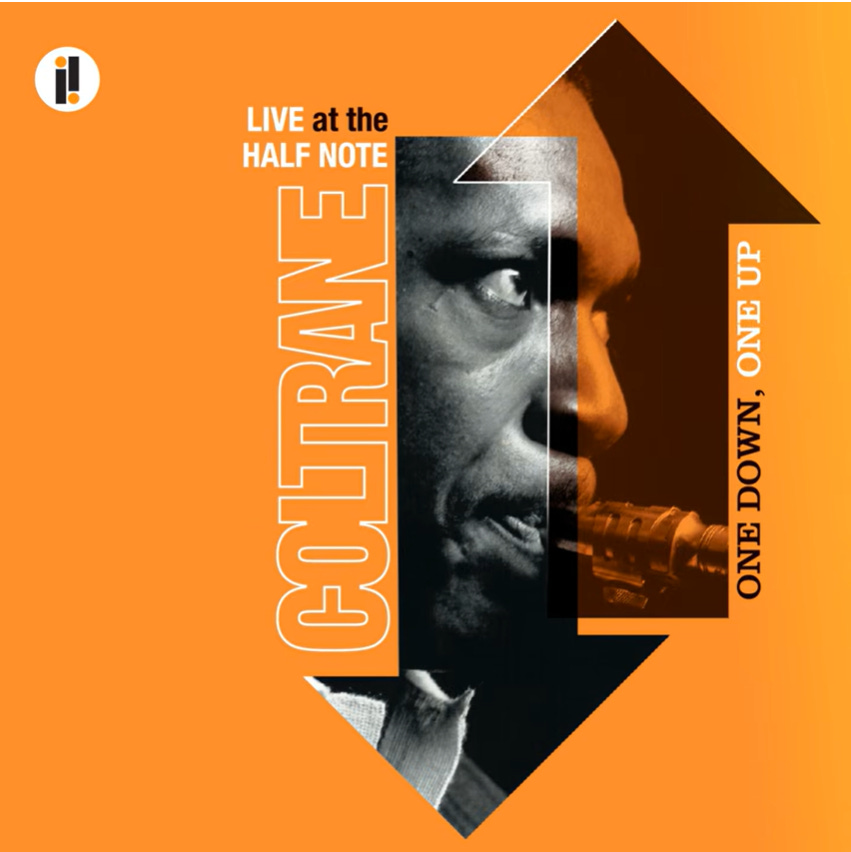
I spent years as a musician, and to me this is just improvisational jazz put in the language of physics. Listen to John Coltrane in his transcendent mid-1960s period on One Down, One Up, the whole quartet untethered and moving as one, building the theme together somewhere none of them could have mapped in advance. Or Miles Davis at the Isle of Wight in 1970, leading an electric band through one unbroken set with no real set list, the music following no form at all, just a theme it kept returning to, as if something were playing through them. When someone asked him afterward what to call it, he said, “Call it anything.” That was the point. In any given second the directions open to those players were close to infinite, and they picked one, the one that became that night. Play it again and it goes somewhere else. You cannot hear the whole song ahead of time. You play the next note, listen to what it opens up, and play the one after that. The music was not waiting to be found. It was waiting to be made.
Musicians and filmmakers just make it visible. It is happening to everyone. Each breath, each blink, each step is a fork, and a world gets chosen. When the way ahead feels narrow, that is usually a trick of attention, not the truth of it. Look again. Every moment is a new universe. Don’t forget to ignore the confusion!
This post was written with input from Claude.ai